Preprint
IORA: Irregular Object Immobilization
under Restricted Actuation
Sang-Hun Han1,
Changyeon Won1,
JunGyu Lee2,
Min-Gyu Park3,4, and
Hae-Gon Jeon2†
1GIST, 2Yonsei University, 3KETI, 4Polygom
†Corresponding author
By using the tabletop as a load-bearing contact, IORA enables a low-DoF coupled hand to immobilize irregular objects under external disturbances.
Abstract
Stable grasping under task-specific disturbances is important for robotic manipulation. However, most dexterous grasp synthesis methods are developed for highly actuated hands in free space, and low-DoF hands may not be able to realize the contact topologies required by these grasps. Meanwhile, support surfaces can provide useful contact forces, but are often treated only as geometric constraints. We present IORA, a support-aware grasp synthesis framework for object immobilization with low-DoF coupled hands. Given irregular object geometry, our method represents both hand and object local surface regions as graphs and searches for kinematically feasible matchings between them. We then refine the wrist pose and motor state for geometric contact feasibility and validate the refined grasps through physical rollouts. Starting from the validated grasp pose, an optional task-guided local search explores nearby grasp configurations by varying the wrist pose and motor state, and selects one according to the specified task condition. Experiments on diverse objects show that our method generates various grasp configurations that achieve high grasp success and strong disturbance resistance. Real-world experiments further demonstrate physically executable grasps which enable object immobilization in cooking scenarios.
Supplementary Video
Method
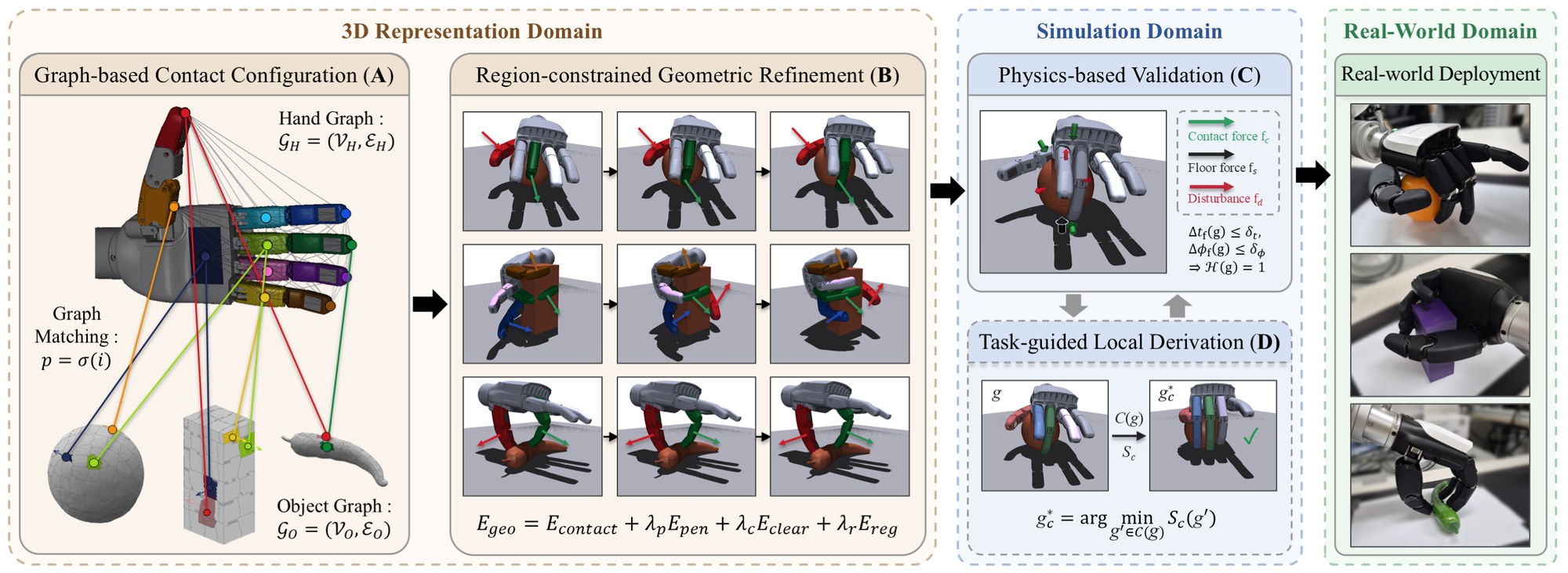
A grasp g = (T, u) specifies a wrist pose T and motor state u, with joint angles constrained by the hand's fixed coupling q = Cu, so every synthesized grasp stays within the configuration space the low-DoF hand can actually reach. (A) Graph-based contact configuration. We represent contact-capable hand regions (fingertips, proximal links, and palm) and object surface regions as graphs, with edges encoding pairwise distances and relative surface-normal angles. We retain only graph matchings whose pairwise relations can all be realized by a single motor state, which turns the coupled actuation into a generation-time condition rather than a post-hoc constraint. (B) Region-constrained geometric refinement. Keeping the matches fixed, we refine the wrist pose and motor state to establish the intended contacts while avoiding penetration into the object or table and unintended contact elsewhere. (C) Physics-based validation. Each grasp is simulated from a pre-grasp pose and tested under constant disturbances along ±x, ±y, and ±z. The hand contacts fc and the tabletop reaction fs support the object; we retain grasps whose displacement remains below the thresholds in all tested directions. (D) Task-guided local derivation (optional). A local search over wrist perturbations, discrete yaw rotations, and motor-state scans adapts a validated grasp to constraints such as tool clearance or directional force resistance.
Why Support-Aware?
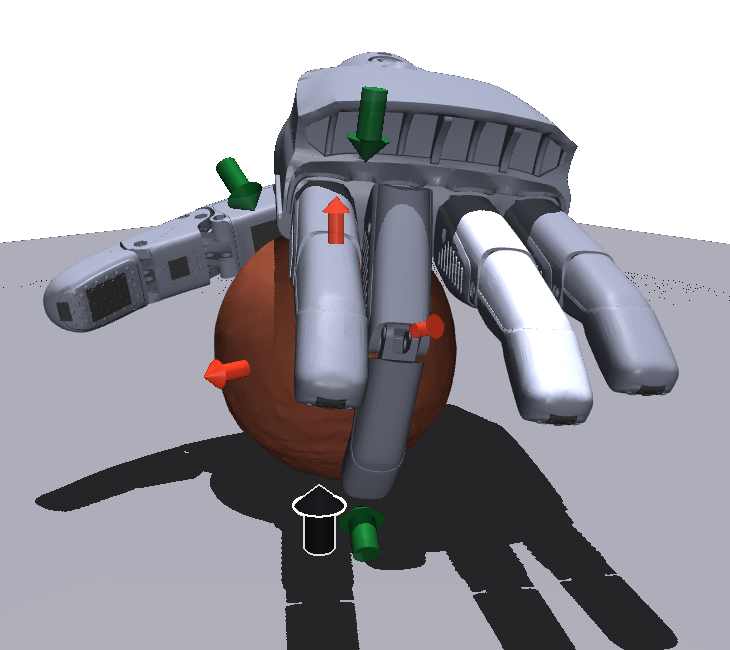
Coupled actuation limits possible contacts. On the Inspire RH56, one motor drives several joints (left: a single actuator bends both phalanges of the index finger). Moving one finger link toward the object also moves the others, sometimes creating unintended contacts or displacing the object. Many contact configurations designed for fully actuated hands therefore cannot be reproduced on the RH56. The support surface can supply the missing opposition. The tabletop provides normal and frictional forces (right) that help resist disturbances without additional actuators. IORA accounts for these forces during grasp synthesis and physics validation, rather than treating the table only as a collision obstacle.
Simulation Results
Disturbance rollouts: baseline vs. ours
Qualitative comparison on DexGraspNet objects
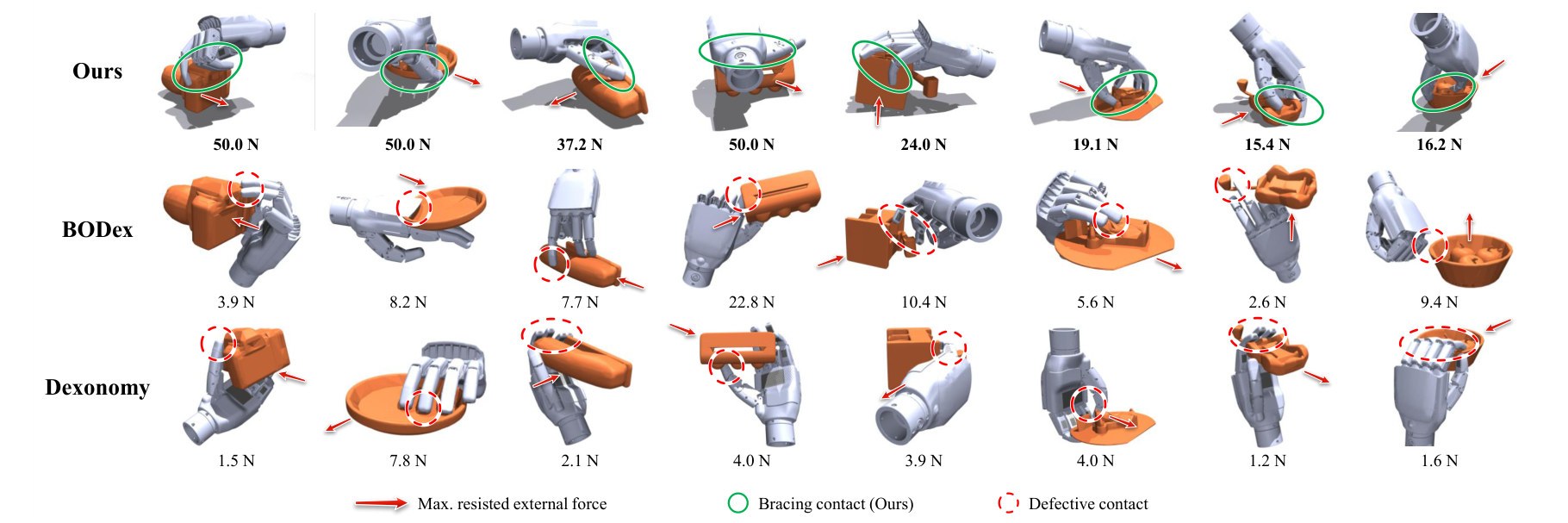
Eight DexGraspNet objects grasped by the RH56, comparing IORA with BODex and Dexonomy. For each grasp, we report the maximum force resisted along the weakest tested direction (red arrow), capped at 50 N in MuJoCo. IORA forms bracing contacts that wrap the object with several finger links and press it against the tabletop, whereas the baselines often show defective contacts such as fingertip-only touch, flat fingers resting on the surface, or one-sided contact without opposition.
Quantitative comparison on the low-DoF RH56
| Method | GSR (%) ↑ | OSR (%) ↑ | Fmin (N) ↑ | Resistance R@F (%) ↑ | |||||
|---|---|---|---|---|---|---|---|---|---|
| F = 5 | 10 | 20 | 30 | 50 N | |||||
| Tabletop | Ours | 77.7 | 88.5 | 10.9 | 68.1 | 53.9 | 37.2 | 27.5 | 18.6 |
| Dexonomy | 80.2 | 42.5 | 3.6 | 37.4 | 18.2 | 2.7 | 1.6 | 0.5 | |
| DexGraspNet | 64.9 | 54.5 | 3.8 | 46.2 | 37.3 | 28.3 | 19.0 | 8.6 | |
| BODex | 62.0 | 77.5 | 3.1 | 40.5 | 28.8 | 14.0 | 7.5 | 5.2 | |
| Floating | Ours | 54.7 | 60.0 | 2.3 | 39.0 | 24.1 | 9.7 | 4.5 | 0.8 |
| Dexonomy | 49.7 | 28.5 | 1.7 | 19.3 | 6.4 | 0.5 | 0.5 | 0.0 | |
| DexGraspNet | 31.9 | 30.0 | 0.3 | 18.6 | 9.7 | 4.7 | 3.2 | 1.1 | |
| BODex | 16.2 | 26.5 | 0.3 | 9.8 | 7.0 | 3.8 | 2.5 | 2.0 | |
Support contribution analysis
| Static force balance | With tabletop | Without |
|---|---|---|
| Feasible grasps (%) | 78.9 | 17.9 |
| Median predicted resistance (N) | 13.3 | 0.0 |
What does the tabletop contribute? For each settled grasp, we use a second-order cone program to check whether hand–object and table–object contact forces can balance an external disturbance under friction and motor-torque limits. We then repeat the calculation without table contact, keeping the hand configuration fixed. Force-balance feasibility drops from 78.9% to 17.9%, and median predicted resistance from 13.3 N to 0 N.
Diverse Grasps on Real Objects
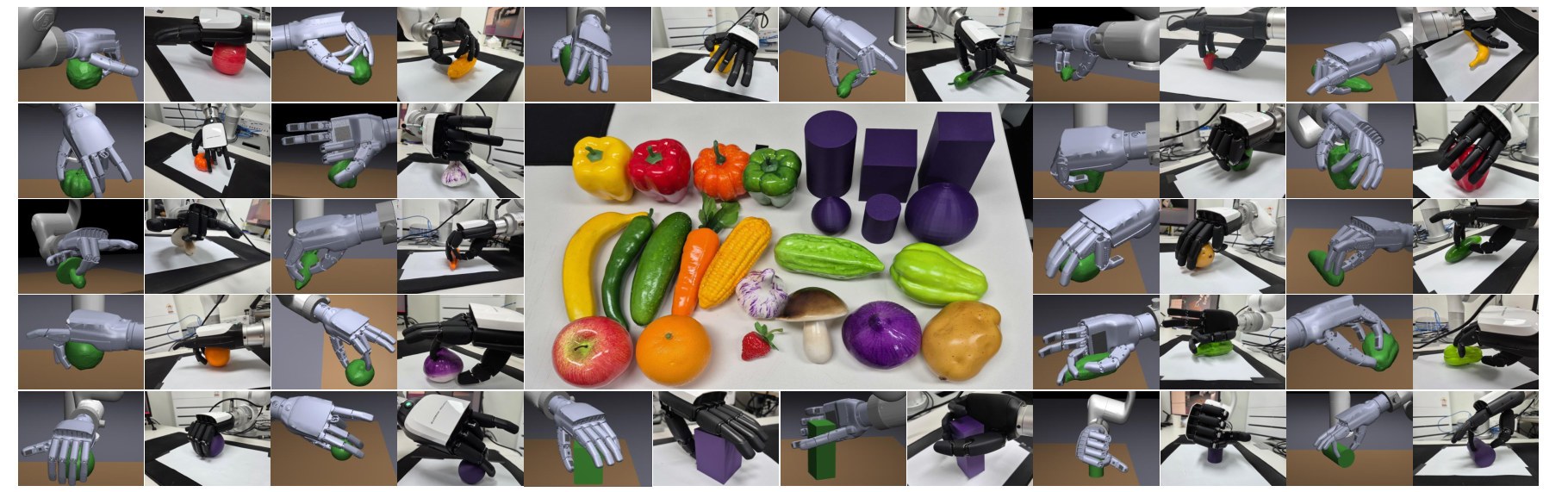
We execute synthesized grasps on the real RH56 for 24 fruit and vegetable replicas and primitive solids (center). Each example pairs the simulated grasp with its physical execution. The contacts involve fingertips, proximal links, the palm, and the tabletop, showing that the synthesis is not limited to a single grasp pattern and remains executable on the coupled hand.
Real-World Experiments
We apply lateral pushes to the objects after the grasps have settled. Hand and tabletop contacts together resist the disturbance. The cylinder grasp also holds after the object is lifted off the table.
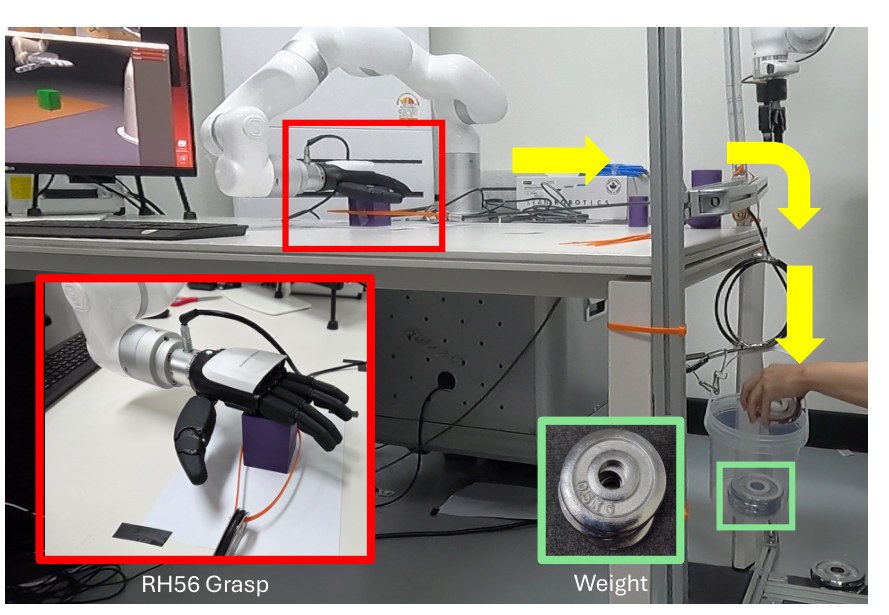
| Real RH56, 6 objects × 3 grasps | GSR | R@10 | R@15 | R@20 | R@25 | R@30 |
|---|---|---|---|---|---|---|
| Success rate (%) | 94.4 | 94.4 | 77.8 | 61.1 | 50.0 | 50.0 |
We test three grasps per object, increasing the applied load in steps up to 30 N. Of 18 grasps, 17 execute successfully, 11 resist 20 N, and 9 resist the maximum tested load of 30 N.
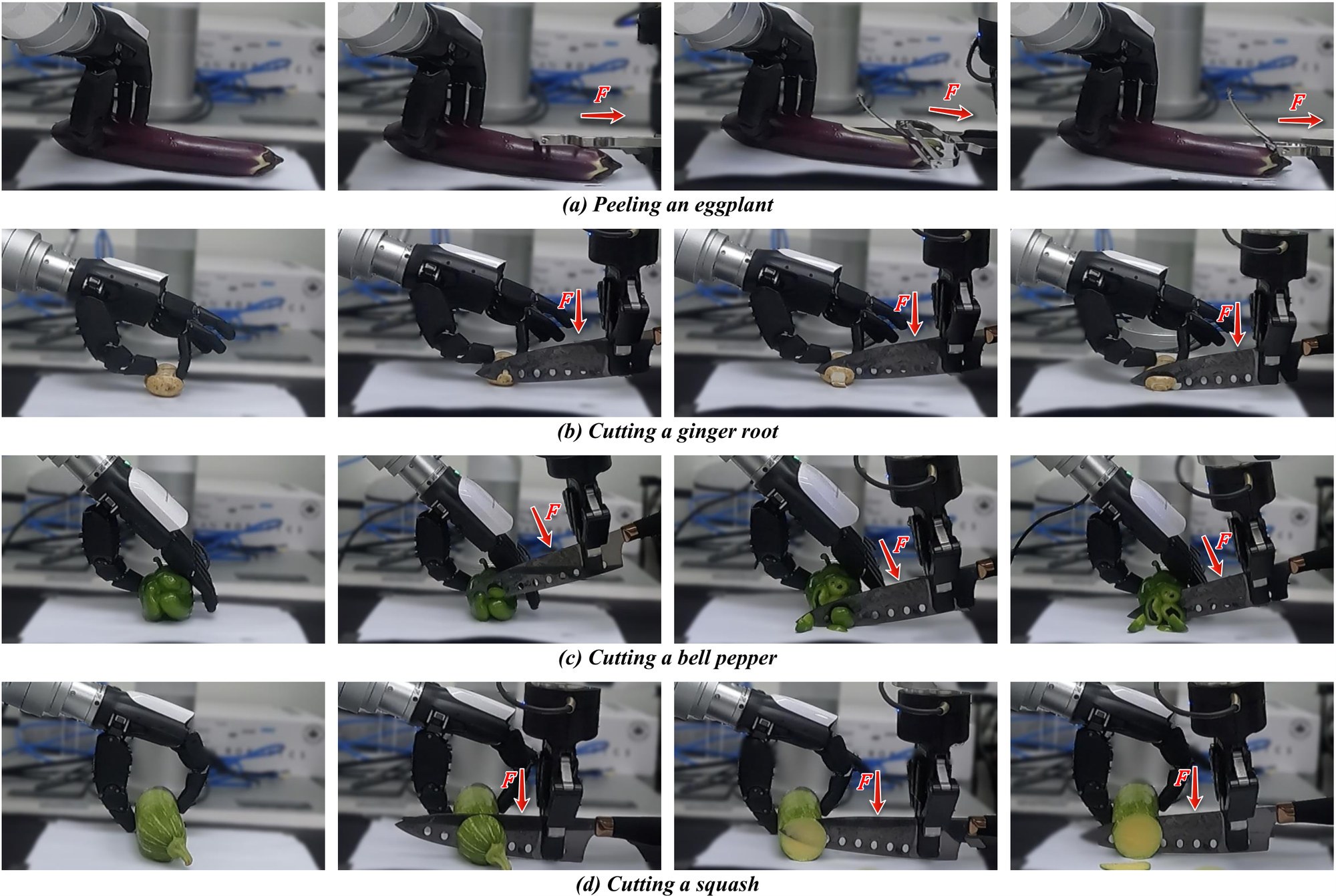
For cutting and peeling, we adjust a validated grasp to keep the hand clear of the tool path. The RH56 holds the vegetable against the tabletop as the teleoperated tool applies force. If cutting changes the object's shape, the pipeline can be run again using the updated geometry.
BibTeX
@article{han2026iora,
  title={IORA: Irregular Object Immobilization under Restricted Actuation},
  author={Han, Sang-Hun and Won, Changyeon and Lee, JunGyu and Park, Min-Gyu and Jeon, Hae-Gon},
  journal={arXiv preprint arXiv:2610.30969},
  year={2026}
}